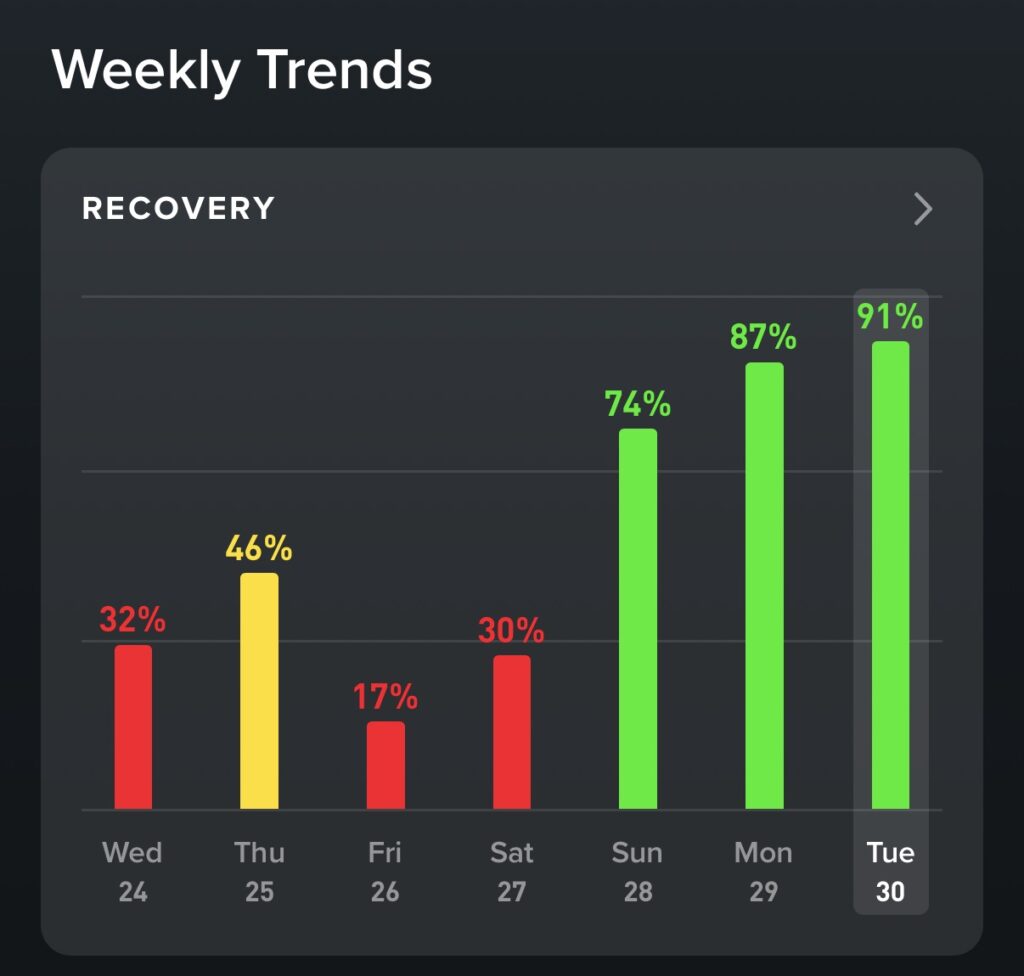
This graph shows my recovery scores from my Whoop band for the last week in June. You can clearly see how up-and-down it is from day-to-day. When I saw this, I knew I needed to blog about it.
If you’ve noticed you’re sore longer, your energy doesn’t bounce back the way it used to, or yesterday’s workout leaves you wiped out for days, you’re not imagining it. Your recovery changes because your hormones change. Here’s how:
1. Declining estrogen slows your body’s ability to repair itself
Estrogen does much more than regulate your menstrual cycle. It also helps:
- Reduce inflammation after exercise.
- Support muscle repair and recovery.
- Protect tendons, ligaments, and joints.
- Improve insulin sensitivity so muscles can replenish glycogen more efficiently.
- Support mitochondrial function, which helps your cells produce energy.
As estrogen declines during perimenopause and menopause, many women notice:
- More soreness after workouts.
- Longer recovery times.
- More joint stiffness (listen to my podcast and hear my friend Terri’s story about this very symptom)
- Greater fatigue.
- Harder workouts feeling even harder.
Please understand this: it’s not because you’ve suddenly become “out of shape.” Your body simply needs more support to recover.
2. Progesterone affects sleep—and sleep is when recovery happens 😴
Many women begin making less progesterone years before menopause. One of the first things to suffer? Sleep. You may fall asleep just fine, then wake up at 2 or 3 a.m. and stare at the ceiling. Sound familiar?? This was one of my first perimenopausal symptoms, and it drove me NUTS because I’ve always been a great sleeper. Now I rely on magnesium and progesterone tabs to get me through the night.
Sleep studies how that deep sleep is when your body does much of its repair work. During sleep, you rebuild muscle, regulate hormones, and recover from training. If sleep suffers night after night, recovery suffers too.
3. Cortisol stays elevated longer
Perimenopause can (and usually does) make your body more sensitive to stress. That doesn’t just mean emotional stress. Your body sees:
- Hard workouts
- Poor sleep
- Under-eating
- Busy work schedules
- Family responsibilities
…as stressors too. When cortisol stays elevated for too long, recovery slows. You may feel constantly tired, struggle to build muscle, and notice stubborn fat around your midsection. It can become a cycle where you’re exhausted, but you keep pushing harder because you think that’s the answer.
4. Muscle becomes more important than ever 💪🏼
After 40, women naturally begin losing muscle if they don’t actively work to preserve it. Muscle isn’t just about looking toned. It helps:
- Support your metabolism.
- Improve blood sugar regulation.
- Increase resilience.
- Recover faster from workouts.
This is why I am constantly preaching about the importance of strength training. Lifting weights, adequate protein, and recovery all work together. You can’t maximize one while ignoring the others.
5. Recovery is no longer optional.
In your 20s and 30s, you could often get away with poor sleep, under-fueling, or training hard every day. We can’t do that forever. Recovery must become part of the program—not a reward after the program.
As an Ironman triathlete, I used to believe more was always better. If I wasn’t exhausted, I wondered if I’d trained hard enough (and I would tell myself that my competition was doing more than I was 🫠). Then perimenopause taught me something I wish I’d learned years earlier:
Your body doesn’t get stronger during the workout. It gets stronger when you recover from it.
Hormonal changes are one of the biggest reasons recovery feels different after 40, but they’re not the only reason. Aging itself affects how quickly we repair muscle and connective tissue. The good news is that many of the strategies that support healthy hormones—adequate protein, quality sleep, strength training, stress management, and proper fueling—also improve recovery.
So, how do you recover like a boss??
5 Ways to Recover Better After 40
1. Prioritize protein after every workout.
Recovery starts with giving your muscles the building blocks they need. Aim for 25–35 grams of high-quality protein at each meal and make post-workout nutrition a priority.
2. Stop treating sleep as optional
Sleep is when your body repairs muscle, regulates hormones, and adapts to training. Protect your bedtime routine as seriously as you protect your workouts. Get it at least 7 hours.
3. Lift hard—but recover harder
Strength training is one of the best tools for women over 40, but your body also needs recovery days. Pencil in at least 1 recovery day (and that can include yoga or walking).
4. Eat enough to support your training (and I’m talking to all of you ladies- not just the endurance athletes)
Many women unintentionally under-fuel. Not enough carbohydrates can leave cortisol elevated, slow muscle repair, and make every workout feel harder than it should. Depending on your personal goals, I recommend at least 180g of carbs each day (and I’m including fruits and veggies as carbs).
5. Make recovery part of your routine
Recovery isn’t just about taking a day off. Hydrate well, include electrolytes when appropriate, manage stress, get daily movement, and don’t underestimate the value of an easy walk or mobility session. 🧘🏼♀️
I know this was a lot, but I thought it was an important topic that needed my full attention. If you have any questions, or need some advice, pls drop them below.
Thanks for reading,
Paige xo
P.S. Have you heard how perimenopause hit me like a freight train? If not, take a listen to my private podcast. Not only will you hear my story, but you’ll also get some great advice from some of my closest friends on how to best navigate this time in your life. 🩷
Leave a Reply